


In a couple of posts here at Front Range Economics, I have been critical of some labor market regulations such as Denver’s minimum wage (see part 2 of my Denver restaurants post) and Colorado’s childcare regulations (see my childcare costs post). For this post, I’ll highlight an area of labor market regulation where Colorado is much less restrictive compared to the rest of the country and make the case that this is a good thing.
To compare Colorado to the rest of the country I will rely on the 2026 edition of the Archbridge Institute’s State Occupational Licensing Index. In this index, Colorado has the 5th fewest occupational barriers and is ranked the least restrictive in the Mountain West region. Colorado restricts among the fewest occupations in the country and has a universal recognition law, enacted in 2020 and revised in 2022, that allows individuals from many occupations licensed in other states to move here, transfer their license, and get to work.
Not everyone views Colorado’s lax occupational licensing as good policy. For instance, in response to the Return to Nature funeral home case, politicians and the public were quick to blame the lack of licensing for creating an environment where this could occur. The state will start licensing some funeral occupations in 2027. I see why the public and the state responded with calls for licensing in this industry, but it’s not clear licensing would have stopped these abuses, and some reporting suggests this was a failure to regularly inspect funeral homes.
Outside the specific case of occupations in the funeral industry, recent research on occupational licensing has shown that there can be benefits to limiting licensing, especially when the case for consumer protection is weak. And Colorado seems to have most of its licenses concentrated in occupations with stronger consumer protection justifications (think doctors and lawyers), suggesting the state’s licensing burden is small relative to more restrictive states such as Oregon. But Colorado is not some occupational wild west.
The rest of this post will elaborate on the case for limiting occupational licenses, present the Archbridge index data for Colorado, and then illustrate one of the limitations of the index when it comes to comparing stringency in licensing across occupations.
Is less occupational licensing desirable?
Occupational licenses act as a costly screen to enter a profession using some combination of minimum requirements. These requirements might include a certain number of educational hours to become a cosmetologist. Or a degree and an exam before receiving a license, as in nursing or law. Other licenses are pretty minimal in their requirements. There might just be an online test and a small fee.
One argument in favor of licensing is that these requirements ensure a minimum level of competency in an occupation and avoid the imposition of search costs associated with figuring out who the decent cosmetologists and nurses are, to the benefit of the consumer. If the state sets standards, all consumers and employers can be reasonably sure the barber or lawyer they’re hiring is not a total fraud. Recent research from economist Nicholas Carollo and co-authors provides some theoretical and empirical support for this argument. They look at the history of occupational licensing in the U.S. and show that occupations are more likely to be licensed the more relevant consumer protection concerns are.
But that doesn’t mean licensing is only ever about consumer protection. Carollo and his co-authors also show that members of some occupations, represented by professional associations, seek licensing laws to protect wages in their industry. They may make public-interest arguments, but they’re after a wage premium. And even if a license or a barrier raised the average quality of service for a profession, that is not an obvious positive for consumers. Consumers who cannot afford the level of quality at the licensed level are priced out of the market. A reduction in entry costs may make it possible for lower quality entrants to offer services at a lower price. Depending on what occupation we are talking about, it may be better to have access to a lower quality version of a service than none at all. Where this is true, it is a point in favor of weakening licensing restrictions.
For something like a doctor or a lawyer, a stronger case can be made for the state stepping in and saying we aren’t going to let these people sell medical or legal services if they can’t meet this standard. Many occupations that are licensed, however, have much weaker consumer protection justifications.
Think about cosmetologists or barbers, occupations requiring many hours of education to obtain a license in most states. Sure, we want our barbers and cosmetologists to be competent, but there are strong market incentives for them to be competent. A barber who consistently gives terrible haircuts or uses dirty tools won’t keep a job for long whether hired by a chain like Great Clips or running their own small business. In these cases, licensing raises the cost of entry, which likely brings a wage premium and higher prices for the service.
Maybe you think the consumer protection case for barbers and cosmetologists is stronger than I’m making it out to be. Fine. But look at the occupations licensed in many states, and it is not hard to see how weak the consumer protection justification is for many of them.
Although I do think there are feasible options for something like private certification to replace state occupational licensing, I don’t see occupational licensing as an illegitimate function of the state. I’m not making an argument for the abolition of all occupational licensing.
I’ll cite another recent paper from Nicholas Carollo to further support the point that while some occupational licensing can be beneficial, this is not true for all occupations. He finds that licensing is generally associated with persistent wage premiums and rising employment, but that for occupations where licensing has a weaker consumer protection justification (he uses the example of florists), employment effects are more likely to be negative. So, in occupations where the consumer protection justification is weak, we may end up with higher prices and less competition. That’s a stronger case for not licensing those occupations.
Now on to the index data.
The Archbridge Institute State Occupational Licensing Index 2026
The Archbridge Institute has published its occupational licensing index since 2023, and I use the 2026 edition here. The full report describes the method in detail, and Edward Timmons (VP of Policy at Archbridge and one of the authors of the report) wrote about the release on his Substack. I’ll briefly go over its methodology so the charts I show are clear.
The index covers 246 occupations and indicates whether each occupation is explicitly licensed or faces a barrier in all 50 states and Washington, D.C. From the Archbridge report on the distinction between a barrier and a license:
In our index, we define a barrier to mean that the tasks associated with an occupational title are restricted by an occupational license. A license is an explicit license for that occupational title. For the state of Alabama, “acupuncturist” has a barrier, a physician license, but no explicit “acupuncturist” license. If the SOLI index were calculated with physicians and acupuncturists only, Alabama would have a barriers count of two and a licenses count of one.
In other words, every license is a barrier but not every barrier is a license.
Using this data, each state is assigned a barrier score and a license score based on the report’s index formulas. These scores capture the breadth of barriers and licenses relative to their respective ranges across states. Finally, the report ranks states from the most restrictive (#1) to the least restrictive (#51) by their barrier score, with ties broken by license score.
In addition to the ranking based on barriers and licenses, Archbridge categorizes states by their universal recognition status. Many states have no universal recognition laws on the books, so anyone who moves there must get a new license, even if they already hold one from another state. But 28 states have some form of universal recognition law. Archbridge categorizes these states by a “medal” status of gold, silver, or bronze. A gold medal state has no “substantially similar” clause and no residency requirement. A silver medal state has a residency requirement but no substantially similar clause. A bronze medal state has a substantially similar clause and may also require residency.
Let’s look at where Colorado lands in this index.
Where Colorado lands
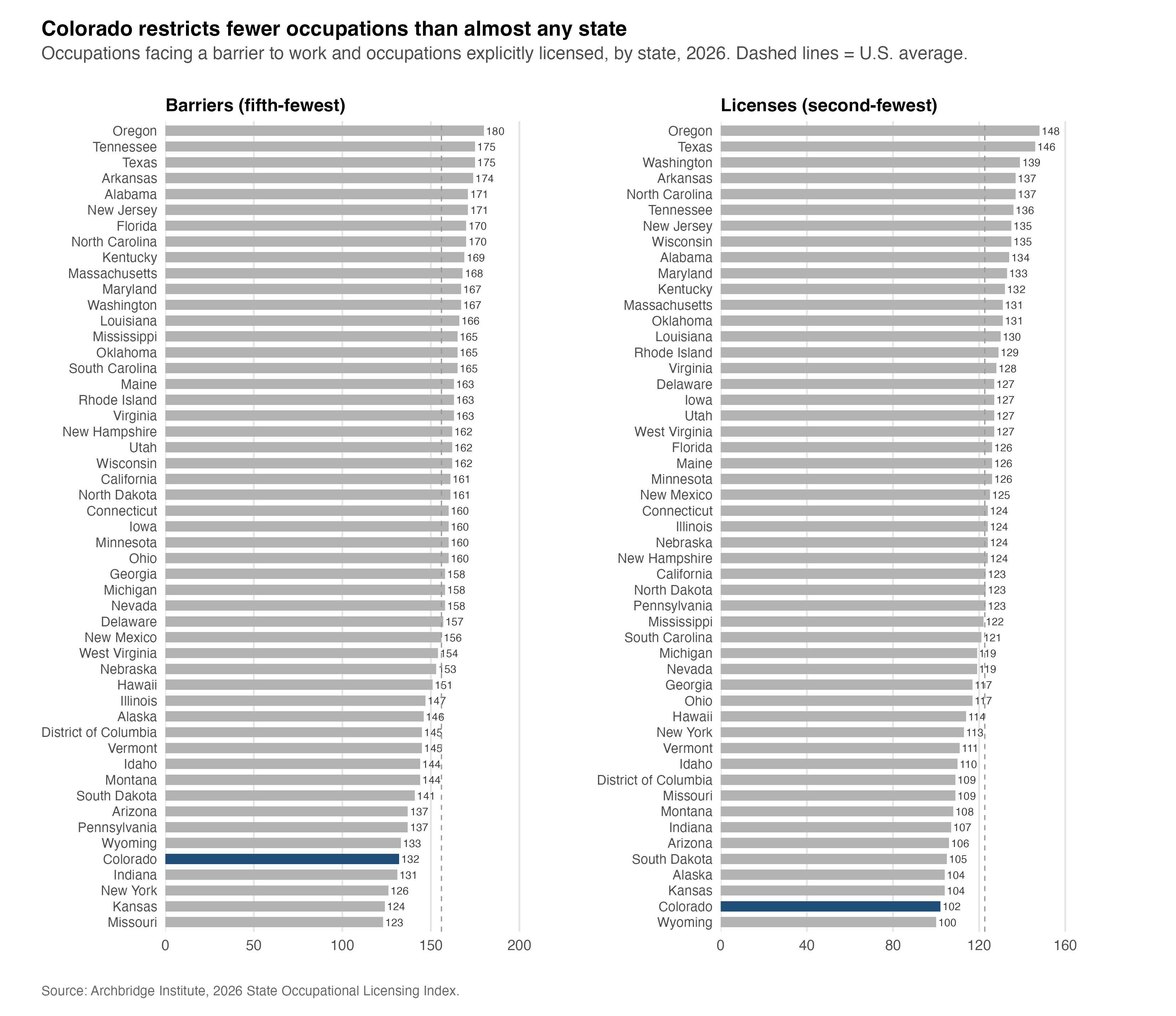
Colorado’s overall ranking in the index is at the 5th least occupational licensing (47th out of 51). Only New York, Indiana, Missouri, and Kansas have fewer barriers than Colorado. There are 132 distinct barriers for occupations in Colorado (5th fewest) and 102 occupations are explicitly licensed (2nd fewest), while the national averages are 156 for barriers and 122.6 for licenses. The charts below show these numbers for Colorado and all other states ranked from most to least. If you want to work in Colorado, there are fewer barriers in your way to get going in an occupation than in many states around the country.
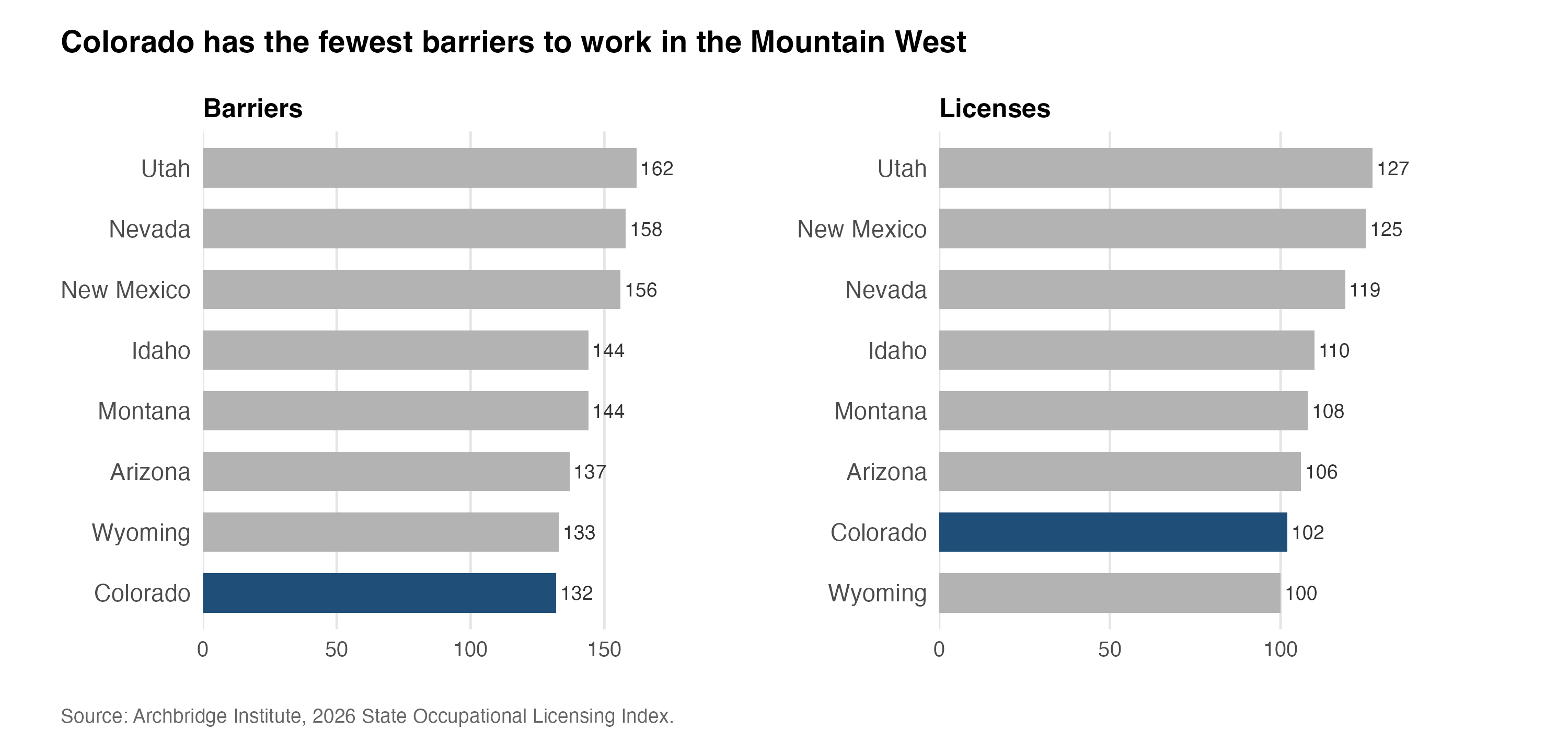
We can also compare Colorado to other states in the Mountain West. In the region, Colorado has the fewest barriers, one fewer than Wyoming, and the 2nd fewest licensed occupations, two more than Wyoming.
Colorado, like every other state, licenses occupations such as attorneys, nurses, dentists, pharmacists, and public school teachers. But Colorado’s most uniquely licensed occupation is psychiatric technician, for which only 4 states require a license. According to the BLS description, a psychiatric technician is someone who provides “care for people who have mental conditions or developmental disabilities” and OEWS data for 2025 shows there are fewer than 2,000 people working in this occupation in Colorado.
For another look outside the index itself but using Archbridge’s data, we can see the occupations that face no barrier in Colorado but would in most other states. The chart below shows 10 occupations where this is true.
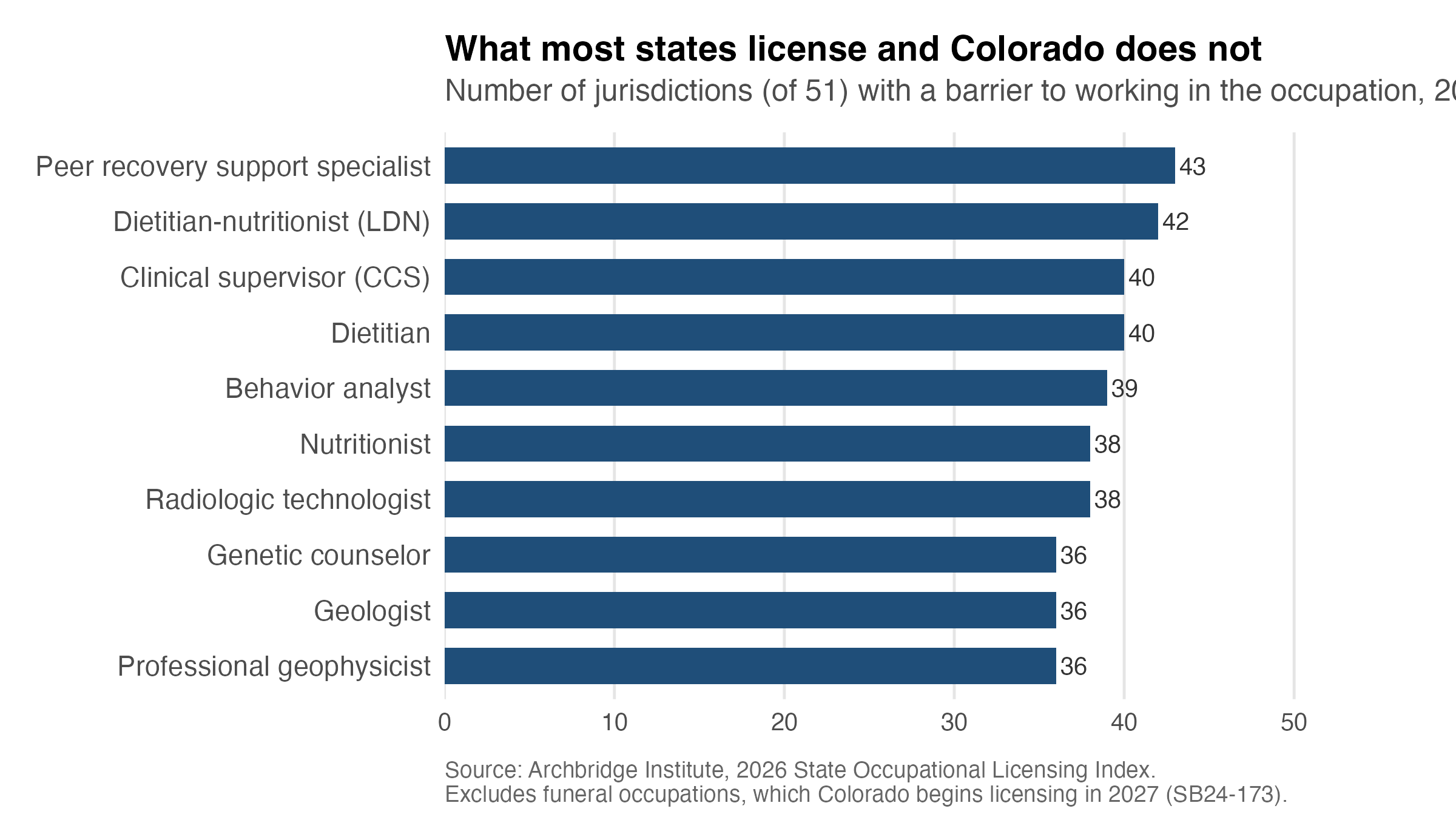
If you want to work in any of the occupations on this list, Colorado is the place to be. At the top is peer recovery support specialist, which has a barrier in 43 states. These are people in recovery from addiction or mental health challenges who provide support for others going through the same. There are also three related occupations (dietitians, dietitian-nutritionists, and nutritionists) that face barriers in most states. Here you might be able to make a strong public interest case for licensing, but there are also many different approaches to diet and nutrition that a licensing program, in an effort to standardize, might restrict. We also have geologists on the list. Who knew Randy Marsh was unlicensed all this time?

On universal recognition, Colorado earns a gold medal thanks to its 2020 universal recognition law that was later revised in 2022. The law created Colorado’s license portability program intended to make it easier for people to move here with an out-of-state occupational license and start working in their occupations. However, two caveats apply to Colorado’s medal status here.
First, the state’s universal recognition law has exceptions for several occupations, including electricians, plumbers, and outfitters. Second, the 2022 revision narrowed the law’s “substantially similar” clause but did not remove all substantially similar language. It allows individuals licensed in another state for at least a year, with a substantially similar scope of practice, to transfer their license. Given there are only three medal categories, it seems fair that the authors of the report placed Colorado in gold. I raise these two points only for additional clarity.
The Archbridge index gives a great overview of where Colorado stands relative to the rest of the country, but no index is perfect. There are some limitations to how the data can be used.
Stringency across a few occupations
I’ll focus on just one limitation in this data, which is that it only looks at the breadth of occupational regulation. Barriers and licenses are counted up and used to make the relative comparisons across states. This makes the comparisons straightforward but won’t tell us anything about how difficult it is to obtain different licenses. If we look at what it takes to get a license in a couple of occupations in Colorado, we’ll get some sense of how much stringency varies. In some cases, the restrictions present barriers to entry that make it much harder for people to work in a given occupation, while others aren’t much more than an application and a small fee.
Take two examples on opposite ends of the stringency spectrum. Requirements to become a licensed pharmacist in Colorado include a doctor of pharmacy degree, 1,500 intern hours, passing license and jurisprudence exams, continuing education hours, and exam fees. I’d say this occupation falls into the more stringent category when comparing occupations and likely does in most states. At the other end of the spectrum, we have an occupation like pyrotechnic operator. This is probably no surprise, but it is a lot easier to obtain a pyrotechnic operator license in Colorado than a pharmacist license. The requirements here are limited to a background check, prior experience, proof of safety training, passing a general fireworks knowledge exam, and a $50 fee.
The point of these two examples is simply to illustrate how different licensing requirements can be. The extent to which Colorado has less of a licensing burden than other states is only partially explained by the breadth of licensing. We would need a deeper look at requirements across all licensed occupations within Colorado and across other states as well as how many workers these rules affect to get a full picture of the burden. Looking at breadth is a good start, but only part of the story.
Conclusion
So who needs a license to work in Colorado? I won’t pretend I can put an exact number on it because of the issues discussed above. But I can say that relative to most other states, there are many more occupations where legal barriers to entry don’t exist in Colorado. Even if you are someone who is generally in favor of regulation, you might also appreciate that Colorado does license the occupations where you’d worry the most about the lack of government intervention, including physicians, dentists, lawyers, nurses, teachers, and so on. What the state does not do (in most cases) is create barriers to occupations like auctioneers or home inspectors, where it is much harder to make the public interest case.