
Note: This post may be cut off in your email. Click the title to read directly on Substack or in the app.
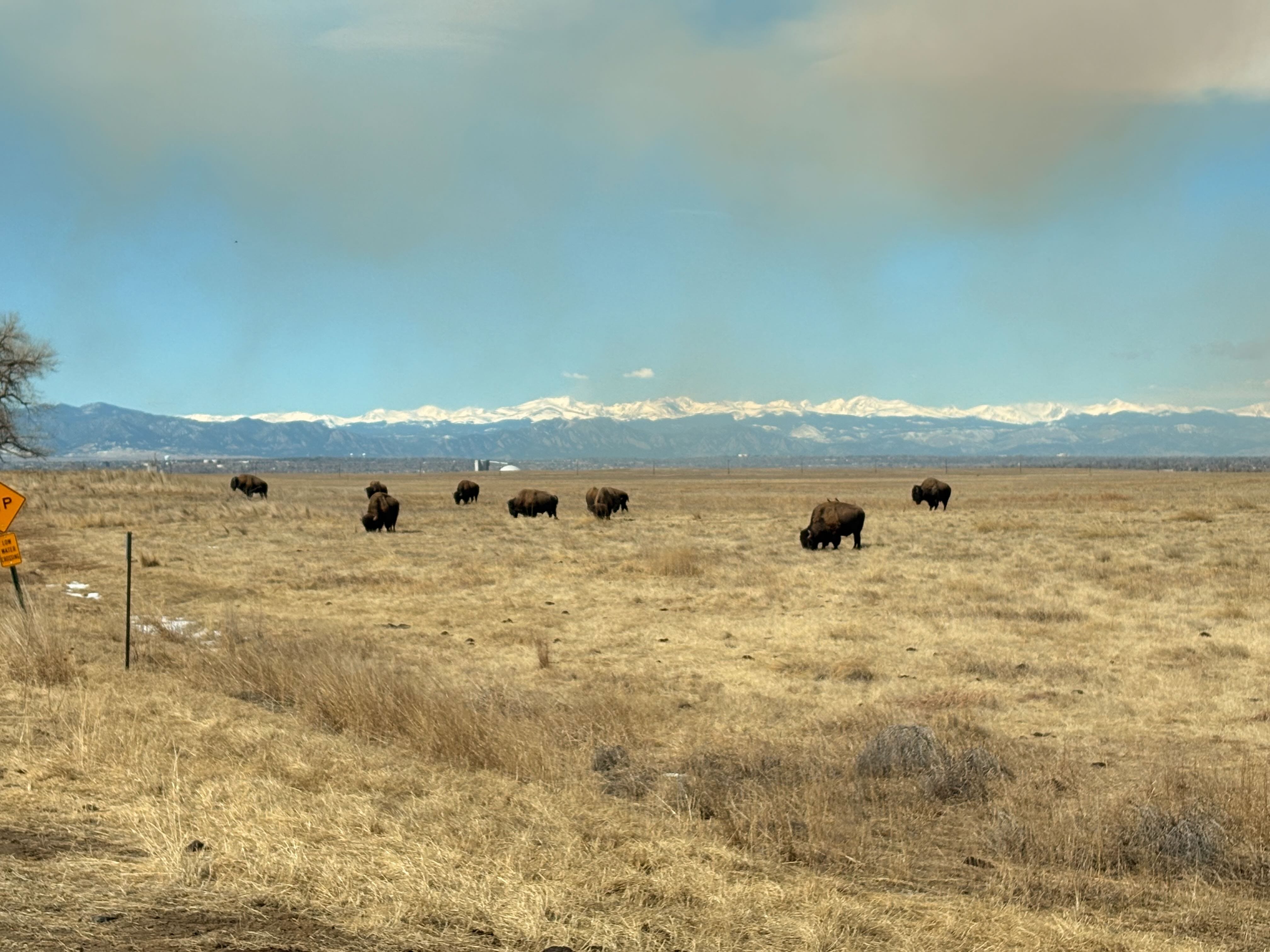
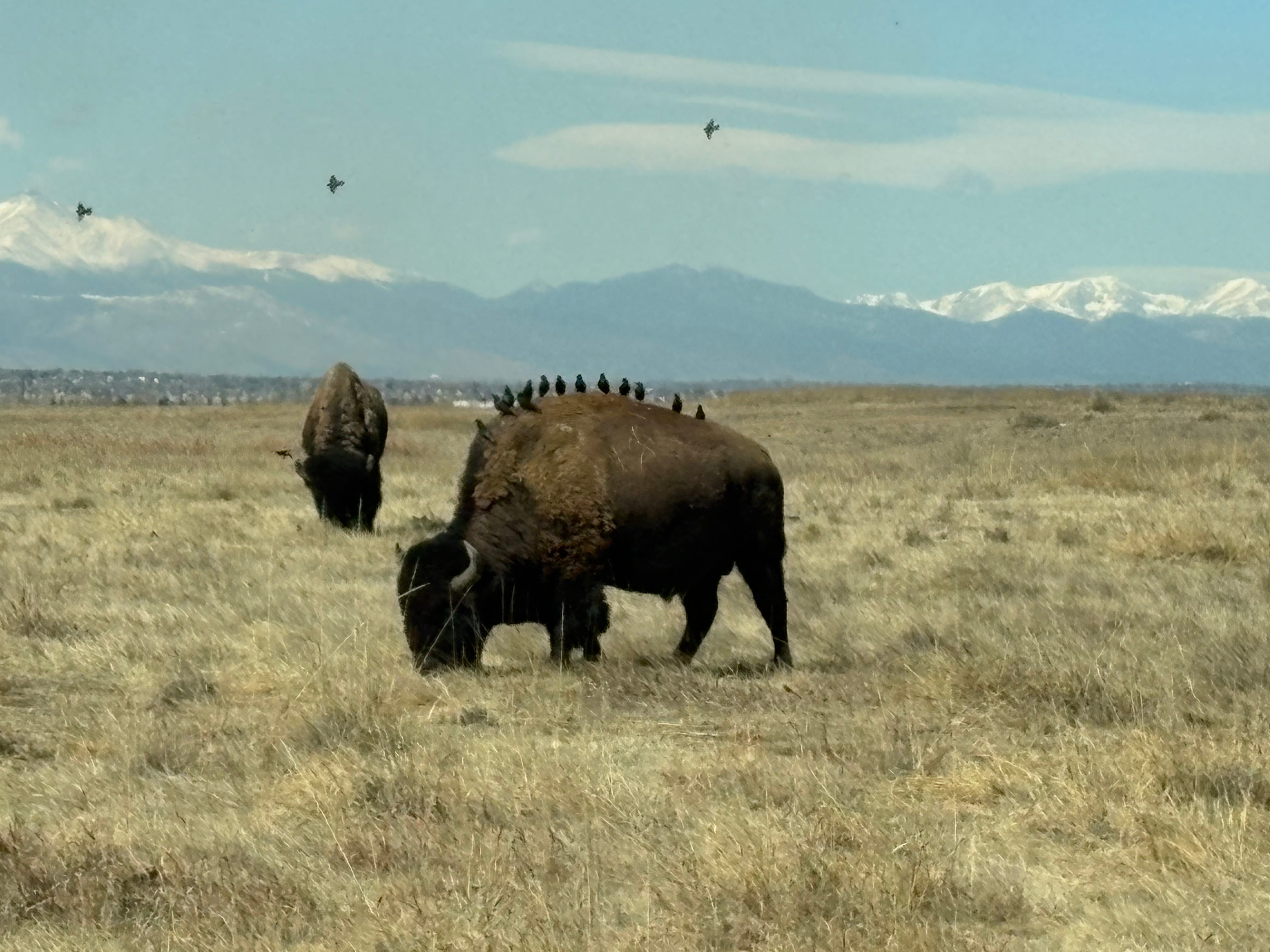
When I moved to Denver, one of the first outdoorsy things I did was visit the Rocky Mountain Arsenal National Wildlife Refuge. “Outdoorsy” being used extremely loosely here since I only did the wildlife drive. Having spent most of my life in Southern California and a few years on the East Coast, being able to see bison up close just a short drive from my new home was a pretty cool experience. I don’t know how people who grew up around here feel about the refuge. Maybe it’s considered weak as far as nature sights go in the area or just a spot for tourists. But since my first time going it’s been somewhere I take family and friends who are visiting.
I came across the Arsenal by accident while working on a paper in my last semester of graduate school. My advisor had been asked to contribute to a special issue on defense economics and came to me to co-author a paper. I had been thinking about this idea on military base closure and we began working.1 In doing research for that project, I read an article discussing the creation of the Arsenal refuge. That paper, “From Weapons to Wildlife: The Transformation of the Rocky Mountain Arsenal,” by Karen Wiley and Steven Rhodes, will serve as one of the main sources I draw from for this post.
The 27 square miles of land just outside Denver that is now a wildlife refuge (most of it anyways) was an Army chemical weapons plant also used by Shell Chemical to produce pesticides for decades. The site itself was heavily polluted with toxic waste from all the chemical production. Then during the 1950s some adjacent farms suffered crop damage and later it was discovered that pollutants had made their way into the groundwater offsite. The Colorado state government, the Army, and Shell Chemical spent years in legal disputes over who was going to clean up all the pollution, who was going to decide the cleanup standard, and how that land might be used in the future. Then, bald eagles were found roosting on Arsenal land, and that discovery kicked off a series of events leading to the designation of the Arsenal as a wildlife refuge.
In this post, I am going to explain how these events unfolded through the lens of the bootleggers and Baptists theory of regulation. The Army and Shell represent the bootleggers, who were responsible for cleanup costs and had an interest in keeping those costs as low as possible. Colorado wanted to set cleanup standards at a level higher than the Army or Shell wanted to pay. It wasn’t until bald eagles were discovered on the Arsenal that the opportunity to lock in land use as open space or refuge was a realistic possibility.
That possibility was appealing to some environmental groups, our Baptists, who could rally public support for turning the old weapons plant into a safe haven for wildlife. But it was also appealing to the Army and Shell as cleanup standards for a refuge would be much lower than almost any other use. And so we have the conditions for our bootleggers and Baptists to work together toward their common goal of creating a wildlife refuge. I’ll start by explaining a bit more about the bootleggers and Baptists theory.
The bootleggers and Baptists theory
The bootleggers and Baptists theory of regulation comes from Bruce Yandle’s 1983 paper published in the journal Regulation. In a later 1999 paper, Yandle summarized his theory as follows:
[D]urable social regulation evolves when it is demanded by both of two distinctly different groups. “Baptists” point to the moral high ground and give vital and vocal endorsement of laudable public benefits promised by a desired regulation. … “Bootleggers” are much less visible but no less vital. Bootleggers, who expect to profit from the very regulatory restrictions desired by Baptists, grease the political machinery with some of their expected proceeds.
His summary is clear but I think Yandle’s idea is best captured in the simple story that gives the theory its name. Here’s my version of it:
Suppose legislation is proposed in a county to prohibit liquor stores from being open on Sundays. The days of Prohibition are far behind us, but it is easy to imagine that there may be some groups, such as Baptists, that support this law on moral grounds. Sure, they might prefer alcohol to be illegal, but closing liquor stores on Sundays is still a win.
The advantage for the Baptists is their ability to rally public support for their cause. You and your neighbors want to look like good Baptists who would keep the county’s residents from being tempted by drunkenness on Sundays. Baptists won’t be alone in supporting this law, however.
Some groups, such as bootleggers, have an economic interest in restricting the operating hours of liquor stores. If liquor stores are closed on Sundays, that is one day a week with less competition for the bootleggers. The problem is bootleggers will find it much harder to drum up public support for their position. Luckily for them, they want the same thing as the Baptists who can drum up that support.
Since Yandle’s contribution, there have been many applications of the theory from other scholars, extensions, and a formal model that captures the dynamics of bootlegger and Baptist behavior including when bootleggers are willing to pay Baptists. Although bootleggers and Baptists need not directly coordinate, the common thread through all this research is that their shared cause increases the chance of success and may create incentives for coordination.
At the Arsenal, the dispute was over who was liable for the environmental cleanup caused by decades of chemical pollution and who would decide how much cleanup should be done. The Army and Shell Chemical represent the bootleggers whose interests were in minimizing the costs of environmental cleanup. They were against the state of Colorado, which wanted to enforce a higher state standard that could have cost the Army and Shell billions more than they hoped to spend. The Army and Shell both fought in court to limit those costs with mixed results. It wasn’t until a Baptist case for lower levels of cleanup could be made that the two got what they wanted. Before I talk about how that happened, it will be helpful to understand more of the background of the Arsenal and the disputes surrounding cleanup.
Brief history of the Arsenal site
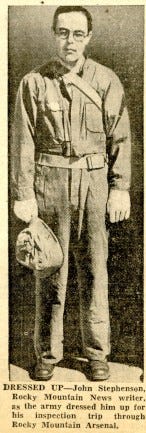
The Rocky Mountain Arsenal was originally constructed in 1942 as a chemical weapons production facility. Reporting on the facility from 1943 suggests that goings-on at the Arsenal were initially shrouded in secrecy, though it was generally known “war gas” was being produced there. In April of 1943, John Stephenson of The Rocky Mountain News took an Army guided tour of the facility and was given a firsthand look at the large-scale production of mustard gas and Lewisite to be used during World War II.
The Army continued to produce chemical weapons at the Arsenal for the next couple of decades, including napalm and sarin. But even as the facility ramped down weapons production at the end of World War II, part of the land and facilities was leased to a private company that was eventually acquired by Shell Chemical (part of Shell Oil). Starting in the early 1950s, Shell used the site to produce pesticides and herbicides. Shell’s use continued for the next 30 years until the end of its lease in 1982.
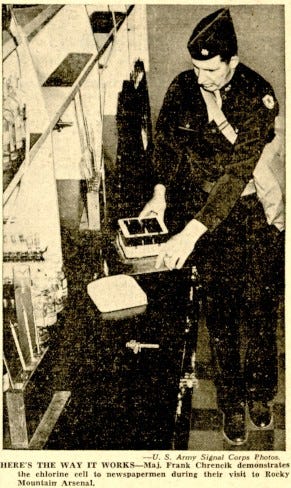
As you might imagine, decades of producing chemical weapons, pesticides, and herbicides, as well as the destruction of unused chemical weapons, created enormous amounts of toxic waste. Much of this waste was stored in man-made ponds on the Arsenal. After production of both weapons and industrial chemicals ended on site, the toxic waste didn’t just disappear. The waste ponds, like Basin F, were still filled. Buildings were contaminated. And the land itself had accumulated toxins. However, not all the toxic waste remained within the boundaries of the Arsenal.
As early as the 1950s there was some evidence of pollution from the Arsenal making its way offsite as farmers faced crop damage, according to Wiley and Rhodes. But it wasn’t until the 1970s that the state of Colorado became more involved. The Rocky Mountain News reported early findings in 1975 of a “substance known as DIMP, a by-product of the detoxification of nerve gas” that officials from the Colorado Department of Health had identified in a few “water wells on and north of the Army’s Rocky Mountain Arsenal.” At the time, there was uncertainty surrounding the toxicity of DIMP, but the findings worried state officials about the full extent of pollution spreading to surrounding land. These findings marked the beginning of legal disputes between Colorado, the Army, and Shell.
The state of Colorado vs. the Army vs. Shell
Almost immediately after the DIMP discovery, the Colorado Department of Health sent the Army and Shell three administrative orders: 1) stop discharging DIMP, 2) clean up its sources, and 3) start monitoring the groundwater. Rather than spend a few thousand extra words describing in great detail the administrative orders, lawsuits, and appeals that unfolded over the nearly two decades between the 1975 DIMP findings and the eventual creation of a wildlife refuge, I am going to limit this to the broad strokes. The three actors of interest at this point in the story are the state of Colorado, the Army, and Shell.
After the Colorado Department of Health discovered DIMP offsite in 1975, Colorado was intent on enforcing state law to hold the Army and Shell financially responsible for cleanup and to have the state, rather than the federal government, set the cleanup standard for the Arsenal. The state wanted an unrestricted-use cleanup standard enforced through Colorado’s hazardous waste law. The state’s position was further solidified as additional offsite contamination was discovered into the early 1980s and Colorado sued the federal government to force it to comply with state authority over cleanup standards.
The Army, on the other hand, wanted to keep cleanup standards and control with the federal government. From the Army’s perspective, much of the Arsenal was already a Superfund site and so belonged under federal law enforced by the EPA. As part of the strategy to achieve federal control in court and in direct response to Colorado’s suit to enforce the state’s hazardous waste law, the Army nominated the Basin F waste pond on the Arsenal to the National Priorities List. Their thinking was that by adding another piece of the Arsenal to the National Priorities List, the EPA’s role in determining cleanup would be solidified. At the same time, the Army wanted Shell to pay for part of the cleanup given the company’s share of the contamination. To this end, the Army sued Shell for cleanup costs. Shell then decided to sue its insurers to have them pick up the bill for any cleanup costs it might be found liable for.
The Army and Shell had pure economic interests in the cleanup costs and did as you might expect. The initial strategy for both parties was to rely on the courts to figure things out. For the Army, maintaining federal control would make it more likely cleanup standards would be lower, and so cheaper. Shell’s hope was a successful suit against its insurers to save on cleanup costs. This strategy proved mostly unsuccessful for the Army and Shell, and it was also incredibly slow.
Despite the sluggish process, in 1984, the Army announced its selection of a $357 million cleanup option focused on what Wiley and Rhodes describe as “consolidation of all contaminated materials in a permanent on-post disposal site.” A year after the Army selected a cleanup option, a district court ruled that the Army and Shell were liable for the environmental damage. This didn’t mean that the state of Colorado would get the level of cleanup it wanted but did solidify who would be financially responsible for the cleanup. Now the uncertainty was over what level of cleanup (and therefore what the cost would look like) was going to happen at the Arsenal.
While all this was going on, the potential for developing land on and around the Arsenal drew additional interests into the central dispute over cleanup. State and city governments, including Denver and Commerce City, were involved in the development of the E-470 highway and a new airport (what is now DIA). Commerce City also saw an opportunity for the development of Arsenal land for commercial or residential purposes. These groups, though not directly involved, had a stake in the success of the state’s case. A higher cleanup standard with the Army footing the bill would open up opportunities for new sources of tax revenue and investment for local developers without the difficulty of figuring out how to fund what could be a multibillion-dollar cleanup.
Something to keep in mind about the cleanup standards dispute is that it is difficult to separate it from questions over future land use of the Arsenal. Colorado’s position was that it wasn’t interested in determining land use. But cleanup standards under the law Colorado was hoping to enforce, like its federal counterpart, are determined by potential risks to people on the land. Those risks are related to expected use, as was recognized by the development interests discussed above. So, we can’t really separate Colorado’s position or the Army and Shell’s positions over cleanup standards from expectations over future use of the Arsenal. Wiley and Rhodes explain how their respective positions were related to land use expectations:
[Colorado] had adopted the position that the arsenal should be clean enough to support relatively unlimited human use, perhaps even residential use. … In contrast, the army and Shell had come to support a selective remediation policy that included on-site pollution containment and treatment. This assumed continued restrictions on public access to and use of arsenal property.
As long as the land use question for the Arsenal remained open, Colorado could fight for the unrestricted-use cleanup standard. If anything were to settle the future of how the Arsenal would be used, particularly if use was restricted, the Army would be more likely to get what they wanted. Then in late 1986, bald eagles were discovered on the Arsenal. It was this discovery that eventually settled the land use question.
The bald eagles discovery
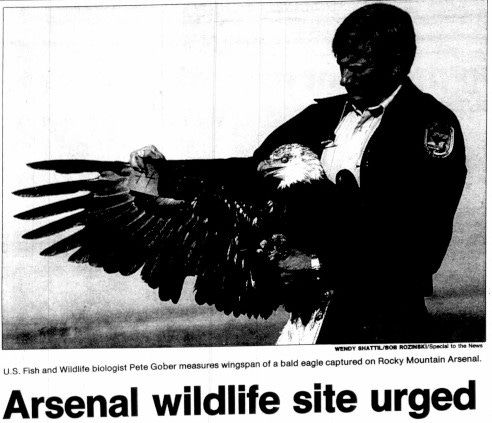
The discovery of bald eagles at the Arsenal brought another government agency into the picture, the U.S. Fish and Wildlife Service (FWS). Bald eagles are “not just any endangered species” but “the national symbol and the longest-standing entry on the list of endangered species,” as Wiley and Rhodes put it. And under U.S. law they are protected not only by the Endangered Species Act but also by the 1940 Bald Eagle Protection Act. The combination of these laws and the fact that the birds were discovered on federal land meant that FWS (quoting Wiley and Rhodes again) “had jurisdiction to take virtually any action it deemed necessary” until the agency figured out what the eagles were doing on the land. As a result, “any activity that might disturb the raptors’ activities was effectively prohibited.”
Some wildlife officials, though uncertain about how regularly the eagles were using the roost at the Arsenal, saw the opportunity for something like a refuge. Pete Gober of FWS was quoted in the Aspen Daily News in 1987 as saying, “If this place could be cleaned up, it could be an amazing urban wildlife area. Amazing.”
The state of Colorado, the Army, and Shell at this point still held their initial positions. But as sociologist Melissa Lynne Hippard explains in her dissertation on the Rocky Mountain Arsenal, the bald eagles “increased the level of interest by wildlife organizations” and “provided a conceptual end use that was federal in status and would satisfy local interest in open space preservation.” As wildlife protection became a clearer priority, the Army and Shell took advantage of the situation.
Bootleggers and Baptists coordinating directly
Much of the interest in wildlife preservation on the Arsenal began with FWS working in conjunction with groups such as the National Wildlife Federation (NWF) and the Denver chapter of the Audubon Society (an organization focused on protecting birds and their habitats). Together they focused on figuring out how preservation could be achieved and found strong public support for the idea. The entrance of these new interests into the land use question at the Arsenal was good news for the Army and Shell. Rebecca Cantwell, writing for The Rocky Mountain News in 1988, put the Army and Shell’s position plainly, writing that they “want a less intense cleanup and support the open space plan.”
Almost as quickly as FWS began their involvement at the Arsenal, Shell and the Army saw the agency and wildlife organizations as allies. If the Arsenal land were to be designated a refuge it would be more likely that cleanup standards would be lower (because of less human use), making cleanup cheaper than if alternative land use options remained a possibility. Shell was quick to put on its Baptist hat before working with groups like NWF and independently hired wildlife photographers to take pictures of animals found across the site. Shell acting on its own in this way may have helped build support for the preservation option, but it would be easy to see through their efforts as a mask for the true interest in lowering cleanup costs. Hippard quotes an anonymous FWS employee who appeared to be thinking along these lines:
I believe Shell and (the) Army looked at it and wondered would it be a little cheaper for us to cleanup to refuge and wildlife standards instead of residential standards.
Shell could do better by coordinating directly with the organizations involved in preservation efforts. According to Hippard, the National Fish and Wildlife Foundation worked with Shell to get money to Denver Audubon to help build public support for turning the Arsenal into a wildlife refuge. Denver Audubon used this money to run public tours of the Arsenal (the Army still controlled access), sell wildlife calendars, and send letters to Congress. Coordinated efforts continued with Bald Eagle Days, events sponsored by the Army and organized by FWS and volunteers from Audubon, which brought thousands of people onto the Arsenal.
Hippard goes on to explain how central the bald eagles were to the efforts to build public support. The Army went as far as working with the Colorado Division of Wildlife and the Colorado State Patrol to bring animal carcasses onto the site when a plague swept through the eagles’ primary food source, prairie dogs. Keeping the eagles around was paramount to solidifying popular support through continued viewing opportunities and making the Arsenal a known location for wildlife viewing just a short drive from Denver. The bootleggers and Baptists dynamic that was emerging seemed to have been recognized by those involved. For example, Hippard quotes an anonymous member of a wildlife organization referring to the “unholy marriage” of “environmental interests and Army and Shell’s interests.”
The first piece of concrete progress toward the Arsenal becoming a wildlife refuge was a Federal Facilities Agreement signed in early 1989 designating “significant portions” of the site as available for use as open space. This was not a permanent designation and Colorado refused to sign on, but it was a formal move in the direction of taking land development options off the table. As these efforts continued and public support for the refuge option grew, the next step was to lobby for legislation. In typical bootlegger fashion, it wasn’t going to be strategically sound for the Army and Shell to take the lead on pushing for refuge designation by the federal government. If they were to get the cheaper cleanup they desired, they needed to rely on another coordinating actor to give the Baptists a stronger voice in the process.
Colorado Representative Pat Schroeder took on that role. Schroeder, encouraged by the NWF, introduced an amendment to the 1990 defense spending bill in the House that would designate the Arsenal as a national wildlife refuge and cap cleanup at the level from the 1989 agreement. This proposal would satisfy the Baptists with a refuge and the bootleggers with a cap on cleanup. But the amendment eventually failed after being met with substantial opposition over the cleanup cap.
One of the most vocal opponents of Schroeder’s amendment was another Colorado politician, Senator Tim Wirth. Wirth was adamant that Colorado should have the authority to set higher cleanup standards at the Arsenal. From Schroeder’s point of view, dragging the already long fight on even longer was going to waste money and risk Colorado losing access to federal cleanup funds. At the time the amendment failed in 1989, The Rocky Mountain News reported that estimated cleanup costs for the Arsenal were between $1 billion and $4.5 billion. And the article goes on to say that Wirth and Colorado Governor Roy Romer acknowledged meeting state cleanup standards would be more expensive. However, for Wirth the issue was enforcing state law, not worrying about how much the Army might have to pay to comply. Schroeder, in contrast, seemed to recognize the need to compromise on cleanup standards to achieve an end use for the Arsenal that many supported.
That the opposition was largely focused on removing the cleanup cap language from the legislation ended up working in Schroeder’s favor. The end use for the Arsenal as a wildlife refuge had broad support. And for the Army and Shell, the end use would still work in their favor. The law did not need to cap cleanup because permanent use as a wildlife refuge would act as a de facto cap. In 1992, the refuge efforts succeeded with the passage of a bill that designated the Arsenal as a national wildlife refuge. The bill also included language making explicit that nothing in it lessened the degree of cleanup already required by law. But existing federal law as enforced by the EPA would set cleanup standards for a refuge much lower than would be the case for industrial or residential use. President Bush signed the bill. Whether the 1992 law wanted it to or not, the land use restriction made the ultimate cleanup cheaper than it likely would have been had Colorado prevailed in court or had other land use options been left on the table.
After the designation of the Arsenal as a wildlife refuge, cleanup took place over the nearly twenty years that followed. Total costs reached just over $2 billion and finished in 2010. Most of those 27 square miles northeast of Denver, for decades the site of chemical weapons and industrial chemical production, is now the permanent home of a variety of wildlife, including mule deer, prairie dogs, bald eagles, and a herd of bison. There were certainly groups that wanted this outcome, but it seems that it wouldn’t have been possible if the Army and Shell as bootleggers hadn’t come together with the Baptists, like the National Wildlife Federation and the Denver Audubon Society. Their coalition and the public support that came with it made the refuge option the path forward to end the years-long stalemate.
It’s possible the Army would have won its fight with Colorado over who set cleanup standards. In fact, the year before the refuge law was signed, a district court ruled against Colorado in its case to exercise cleanup authority over the Army. But then in 1993, after the refuge law passed, a federal appeals court ruled in favor of Colorado on appeal. By that time, however, the Arsenal was already designated as a national wildlife refuge. Even with the state’s authority over the cleanup recognized, the future use of the land was set. Colorado’s position of pushing for residential-level cleanup was no longer compatible with how the land was going to be used. The durability of the refuge arrangement would have been much less likely without the help of some environmentalist and bird watcher Baptists. When the focus shifted to protecting wildlife, popular support contributed to the political incentives of those like Representative Schroeder to act on creating the law that would make permanent the future use of Arsenal land.
Conclusion
In many applications of the bootleggers and Baptists theory, we have private interests seeking profit as our bootleggers. As public choice teaches us, however, economic incentives do not end at the market. Shell was a classic profit-motivated bootlegger in this case. But the Army too was interested in minimizing the costs of cleanup. Money spent on cleanup by the Army could not be spent on other priorities and so the economic interests are much the same.
The more difficult question about this story is what may have happened to the land without the refuge law. There’s some version of the world where cleanup was much more extensive and that land was opened up for broader development. Surely that would bring its own value and maybe more than created by the refuge. But it’s not clear that path was a realistic option. The intergovernmental disputes would have dragged on and on in court for who knows how long, and eventually developers and other interests would have moved on to other opportunities. The Arsenal was also reported to be the “most polluted piece of land in the country,” a claim at least somewhat supported by the site’s Superfund status, and this made the risks of future liability even after cleanup much higher. Maybe a place where people can drive to see a bison herd just outside Denver is good enough.