


Over the last few weeks, I have not been posting as much because of a pretty big life change. My daughter was born at the end of May and most of my attention has been on her and my wife at home. We are fortunate enough to both have substantial time off from work to be at home with the baby but soon enough we will be facing the problem that most working parents face. How are we going to adjust to the looming childcare expense?
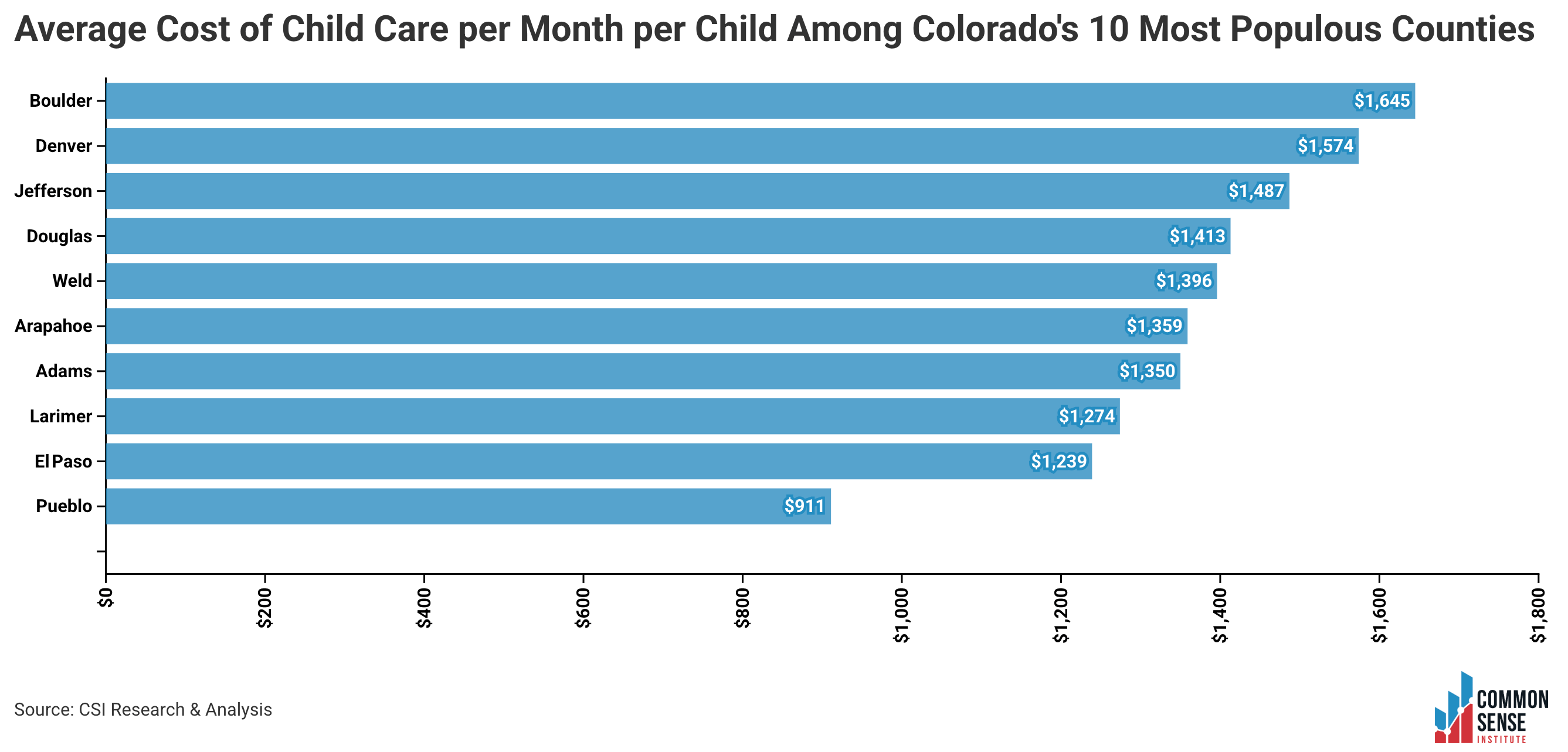
Working parents around the country, especially those without extended family to lend a helping hand, are faced with difficult financial choices when it comes to finding childcare. According to data from a report published by the Common Sense Institute, average monthly childcare costs in Denver are $1,574 and Boulder County tops the state’s most expensive counties with average monthly costs over $1,600. Compare these average costs to average wages in Denver and parents are spending 18% of their paycheck on childcare and even more in other Colorado counties.
The financial difficulties extend to providers as well. The Colorado Sun recently covered how providers like a daycare in Boulder operate on increasingly thin margins despite rising costs for parents. Leadership within the daycare quoted in the Colorado Sun article emphasizes that many of these difficulties stem from declining government support such as the freeze in the Colorado Child Care Assistance Program.
I think few would disagree that rising childcare costs pose a problem for working families but there is considerable debate over what is causing it and what can be done about it. What I want to focus on here are a few explanations for why these costs are so high in the first place. The first is the “Baumol effect” or “cost disease.” Second is how regulations, looking specifically at Colorado, can increase costs. And lastly I’ll offer a less often discussed factor on the demand side.
The Baumol effect
The Baumol effect or cost disease idea goes back to the economist William Baumol, who developed a straightforward theory to explain how differences in productivity growth across sectors of the economy could result in diverging costs and ultimately prices of outputs. I’ll give my simplified retelling of the theory.1 Start by assuming there are two sectors in the economy, the goods producing sector and the services sector. In the goods producing sector, labor productivity can be easily augmented with capital or technology and in the services sector, which is more labor-intensive, productivity remains relatively constant, largely unaffected by increasing capital and technology. Rising productivity in the goods producing sector pushes up wages there. But if workers in the service sector can move between sectors, they won’t just ignore the opportunity for higher wages. And this could mean fewer workers in the service sector to produce output if employers do nothing. What can employers in the service sector do to try and keep workers? They can offer higher wages to workers to keep them around, even though there has not been much rise in productivity. When input costs (like workers’ wages) rise without a corresponding increase in productivity, relative prices must rise and output may fall.
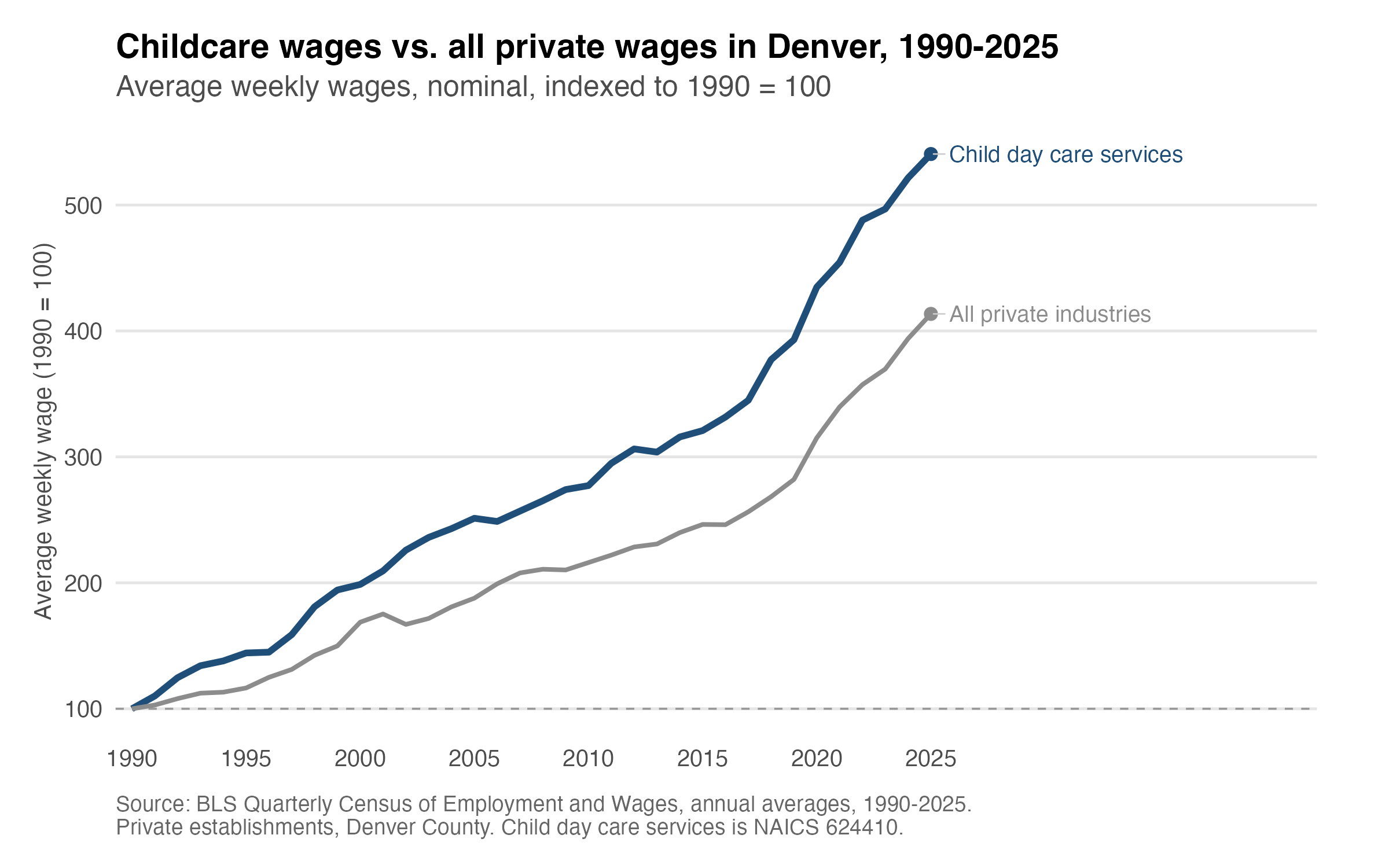
Childcare is a labor-intensive service, so Baumol’s theory might help explain its rising costs. You need people around to take care of all those kids and there’s really not much machines or technology can do to change that (yet?). We should then expect that for the childcare industry to keep workers it must pay them more. The theory does not predict that childcare workers are making great money, only that their wages are growing over time relative to their productivity growth. A simple comparison to see if we have evidence in favor of the Baumol effect for childcare is to look at growth in average wages in childcare compared to growth in average wages for all private industries as shown in the chart below for Denver County going back to 1990. Average wages in childcare have shown a more than 5x increase over the period while average wages in all private industry have gone up about 4x. Childcare costs are high and wages are growing, so Baumol’s theory is probably part of the story here. But that doesn’t mean this theory can completely explain why childcare costs are so high.
Childcare regulations
Another factor that contributes to high childcare costs is regulation. Childcare regulations include restrictions on daycare facilities like how many square feet of indoor space per child or fence heights for outdoor areas. They also include thresholds for child-to-staff ratios and licensing requirements for operators and staff. The Archbridge Institute has a state-level dataset that provides useful details on these sorts of regulations. Colorado is about average on the strictness of its childcare regulations.
Depending on their stringency, these regulations can restrict supply and put upward pressure on operating costs. How much this is contributing to the rising costs of childcare is up for debate. Alex Tabarrok has written that the Baumol effect likely dominates by comparing rising costs in the more heavily regulated childcare sector to those in the lightly regulated pet daycare sector. But some regulations specific to childcare can also interact with the Baumol effect. Take child-to-staff ratio regulations.
Colorado, like many other states, varies its child-to-staff ratios by age. The ratio is lowest for the youngest groups with 5 children per staff member from ages 0 through 2.5 years. That number jumps up to 8 for 2.5 to 3 year olds and then all the way up to 15 for 7 to 8 year olds. Suppose we have a daycare for children 0 to 2.5 years old that is about to open. The daycare has 10 children signed up for the coming month and must have at least 2 staff members to meet these regulatory thresholds. If the daycare is to sign up just one more child, it would have to hire another employee or risk being in violation of the regulation. Even at the state minimum wage of $15.16/hour, an additional full-time employee creates more than $2,400/month in additional labor costs. Either enrollment must be capped or the daycare charges enough to at least cover labor costs.
It is not that these child-to-staff ratios are unreasonable. I certainly wouldn’t want to send my daughter to a daycare where one employee is trying to take care of a dozen infants and toddlers by themselves. But these thresholds create hard cutoffs that reduce the flexibility of care centers. That lack of flexibility can increase operating costs and contribute to higher prices. But higher prices are not just a matter of operating costs, we need to look at the demand side as well.
Demand for childcare
Like I said above, regulation or not, I wouldn’t send my daughter to a daycare that couldn’t give her the time and attention I thought was necessary for her to be happy and properly cared for. I am not alone there either. Most if not all parents feel similarly and I don’t think it stops there. Maybe part of the rising cost of childcare is not cost disease or regulation but a rise in quality that people are paying for.
It is not exactly fair to say that this demand story is totally unrelated to the cost disease. As Tyler Cowen points out in a 1996 comment on Baumol, there is an optimistic version of the cost disease argument in Baumol’s own work. Rising productivity in some parts of the economy increases the opportunity cost of production in the less productive parts (the arts in his case, childcare here), so prices rise and output may fall. But rising productivity also means rising incomes. As incomes rise, people are willing to pay for services like childcare even at higher prices, so output may not fall and could even increase. Cowen then goes further and argues against the cost disease in the arts altogether. The arts were never stagnant, he says. The arts kept improving, so comparing the cost of a performance today to one decades ago is comparing apples to oranges. Part of what looks like the same thing getting more expensive is people paying for a better thing. A version of that argument applies to childcare too.
Parents have gotten richer, and I believe that shows up in two ways here. They are willing to pay more for childcare, and they are willing to pay for a higher quality version of it. You can see the second one all over the Denver area. La Petite Academy, a national chain of childcare centers with several locations in Denver’s surrounding counties, streams live video of the classroom to parents, provides mathematics in their early preschool curriculum, and boasts dedicated adult attention for infants through an assigned primary caregiver. The Gardner School in Denver sends real-time updates through a parent app and emphasizes research-based S.T.E.A.M. activities. The Gardner School even offers enrichment programs for children as young as two with options like dance, karate, music, cooking, computers, and foreign language. If you want to start foreign language learning for your child even sooner, Denver International Schoolhouse in Aurora will start your infant on Spanish immersion. These are just a few examples from a quick search of additional services beyond basic childcare offered by many providers.
Much of this was not on the menu a generation ago or at least available to the extent it is now. So even if parents today buy about the same hours of care each month as parents did 30 years ago, comparing cost per hour over time is not comparing the same product. But this raises a question. If some of these quality improvements like the live streaming and apps are technology based, why would this make childcare more expensive? Notice that many of these quality upgrades still lean heavily on labor. The language immersion, the STEM classes, the enrichment programs all require people, and people whose time is not easily augmented with capital or technology. These kinds of quality improvements are expensive to provide and are not the same product as basic childcare. Even if the examples I listed capture only part of the market (the more expensive end), this will still be part of the rise in average costs. Although it is likely that basic childcare is getting pricier, parents are also choosing to buy a higher quality version.
Conclusion
Childcare is expensive and likely will continue to be that way. Perhaps easing some of the more stringent regulations can help. One candidate would be licensing exemptions or lighter requirements for smaller daycares, say something like 10 children or fewer. Under current Colorado law, child care licenses are required for any regular care of more than four children or more than two children under the age of two. If you have two kids and want to hire a nanny, the nanny doesn’t need to be licensed. But if you and a couple of neighbors, each with two kids, wanted regular care provided by one parent who stays home or to split the cost of a couple nannies, then a license is necessary.
A broader exemption or lighter requirements (along the lines of this suggestion from Kelsey Piper), not necessarily completely unregulated, could open up the possibility for a daycare analog to homeschooling pods or “microschools” that became more popular during and since the pandemic. No one bats an eye at having your friends or neighbors watch your kids or hiring a nanny on your own, so why not create a more conducive environment for families of young children to create daycare pods or something similar?
A daycare pod doesn’t get around the issue of childcare being labor intensive, but it creates some flexibility not allowed by current regulations. And because pods are small and more individualized, they may be able to more easily meet the idiosyncratic demands of families in different communities. On the cost side, expanding supply should ease some of the upward pressure on prices. And it seems easier to work out alternative arrangements among families to share responsibilities or otherwise reduce the financial hit associated with traditional childcare.
For Baumol’s original paper see here. For a more recent treatment and application of Baumol’s ideas to different services see Eric Helland and Alex Tabarrok’s book.
I really appreciated your assessment of the cultural economics of parenting, especially the way you examine how we approach it socially, emotionally, and financially, from both a parent and labor perspective. Looking forward to reading more of your work!
Excellent assessment. I also wonder whether, given that parents are having somewhat fewer children, if the cost of higher quality childcare is part of the demand for higher quality inputs into child raising, of fewer kids.