


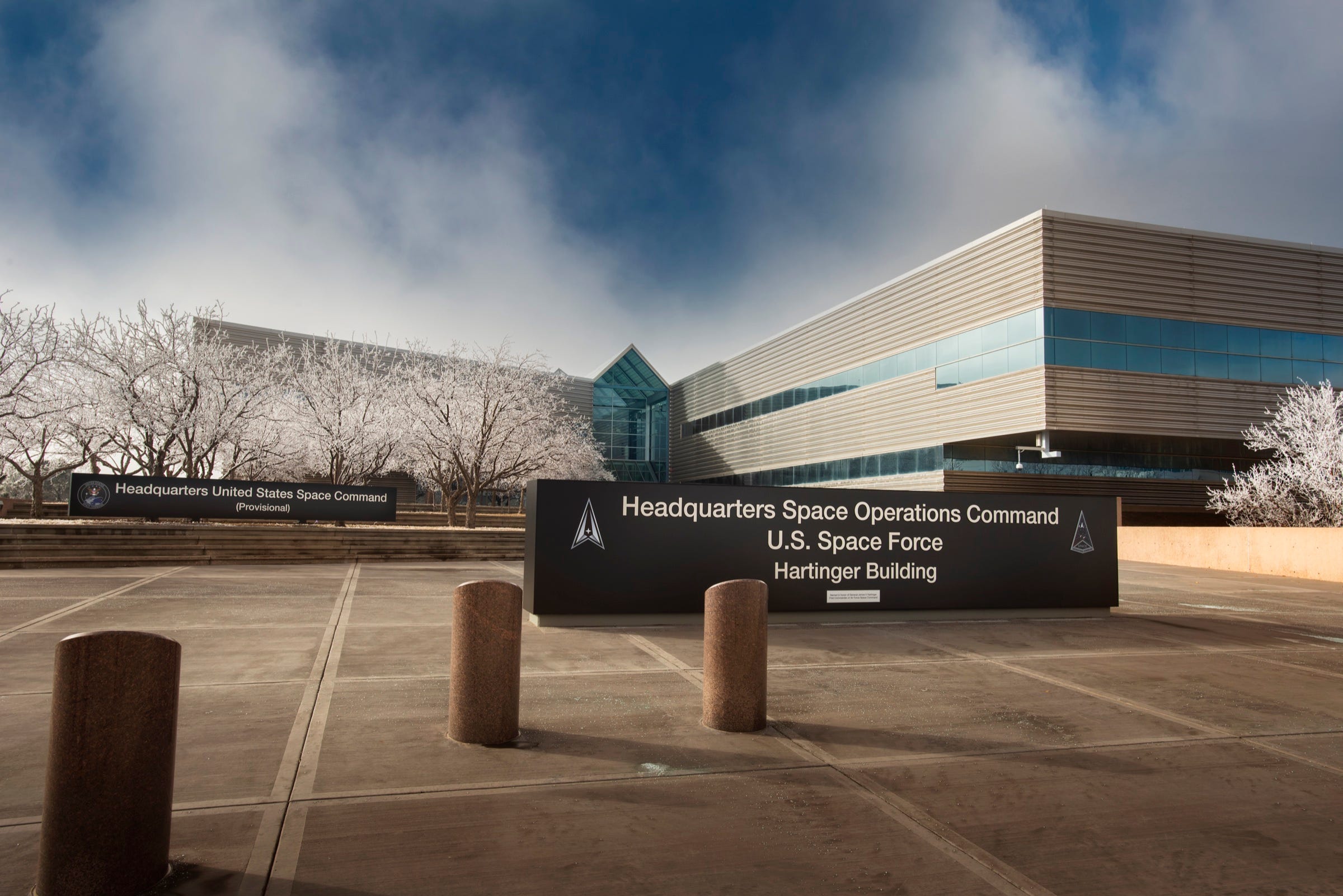
Not long after the 2024 election, two Colorado news stations asked me to give some commentary on the potential move of Space Command’s HQ from Colorado Springs to Huntsville, Alabama.
At the time, the move had not been made official, but Trump had been hinting at a reversal of Biden’s decision to keep Space Command in Colorado. Days after the election, Representative Mike Rogers of Alabama was claiming Trump would quickly sign an executive order to make the move to Huntsville. In both interviews I did, the focus was on the expected economic fallout Colorado Springs might face if the move were to go through, which I knew a decent amount about after recently publishing a paper on military base closure and related policies.
The questions local reporters asked were related to the concerns that typically come up when a base or other military installation is set to close. What about the local economy? Won’t this have massive ripple effects?
Fast forward two years and it turns out Trump did eventually move to have Space Command relocated, and the transition to Huntsville is already under way and expected to be completed by 2032. So, I want to revisit this question because it’s fairly straightforward to see that the local economic effects of this move should be minor.
Military base closures and local impacts
In my paper mentioned above, written with Chris Coyne, we talk about the history of base closure processes, which I’ll briefly summarize here. This isn’t entirely relevant, since moving Space Command HQ isn’t a base closure, but it will help illustrate the concerns that come up.
Prior to Congress gaining more control over base closures, the Secretary of Defense had discretion over which bases closed. So, as priorities changed after World War II, many bases were closed. In just five years (1960-1965), over a thousand bases (not all domestic) were closed under the Secretary of Defense’s authority. In some areas, a military base closing meant a huge loss of jobs and economic activity. And this, of course, got back to the people’s representatives.
By the late 1970s, Congress had made it much more difficult for the Secretary of Defense to close bases and made it easier for individual members of Congress to resist closures that might affect their constituents. This led to a complete stop in base closures for a decade.
Then, in 1988, the first round of Base Realignment and Closure (BRAC) passed and completely changed how bases were closed. I will not get into the details of BRAC here (read my paper or the Wikipedia link if you’re interested). I bring it up, however, because after BRAC a lot of empirical work was done investigating the economic effects of base closure.
One of the results from this research is that job losses are often limited to the direct job losses associated with closure, meaning the positions on the base itself. What this tells us is that to get a sense of how much of an impact to expect from a closure or a move of operations, we should focus on the scale of direct job loss and how quickly it occurs.
Space Command HQ losses vs. the El Paso County economy
According to reporting on the HQ move, the expectation is that there will be somewhere around 1,400 positions relocated from Colorado Springs to Huntsville over the course of the transition. But 1,400 positions moving doesn’t mean 1,400 people currently working at Space Command HQ will be leaving Colorado Springs. About 60% of the staff are civilians and are not under orders to move to Huntsville. Some may choose to stay and look for other work and some may make the move.
Let’s first put the scale of jobs in perspective. El Paso County, where Colorado Springs is located, had around 301,600 payroll jobs as of the first quarter of 2026. The expected job losses put the move at less than a 0.5% decline in payroll jobs for the county.
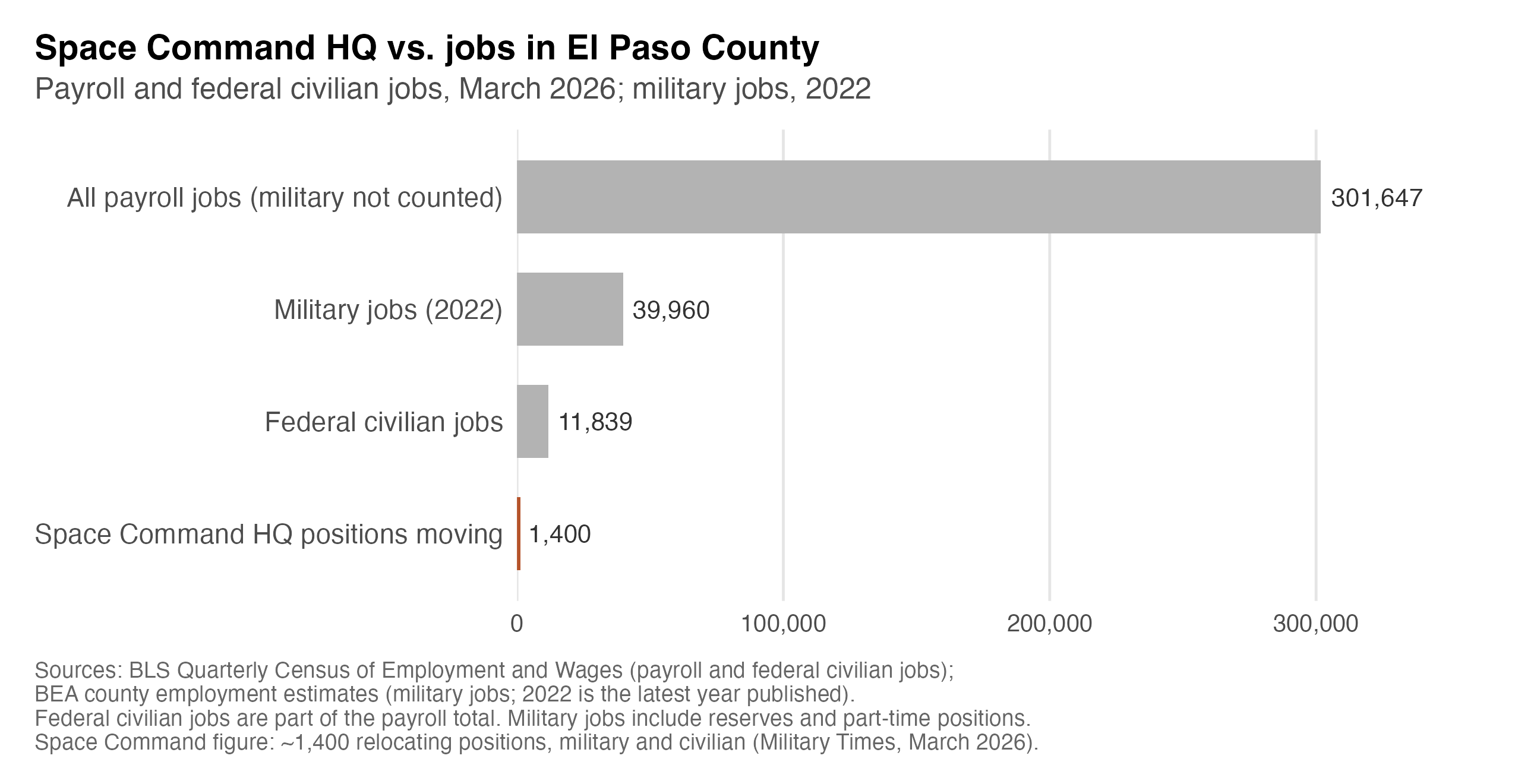
However, the payroll jobs data does not count military personnel. The BEA unfortunately discontinued its county-level employment data, so the most recent data on military jobs in El Paso County I could find comes from 2022, when there were nearly 40,000 military jobs (including reserves and part-time positions). Then we have the federal civilian workers from the payroll jobs data at nearly 12,000 jobs. So, even if we restricted our attention to the military and federal workforce in the county, the 1,400 positions would still only represent a roughly 2.7% decline. While the comparisons are not perfect, they do show that the positions moving out of El Paso County do not amount to a major employment shock.
On top of the small scale, these job losses are not expected to come all at once. This move is planned to happen in phases over several years. If the question is how the local economy will deal with these losses, the simplest way to put it is that it’s not going to be all that noticeable.
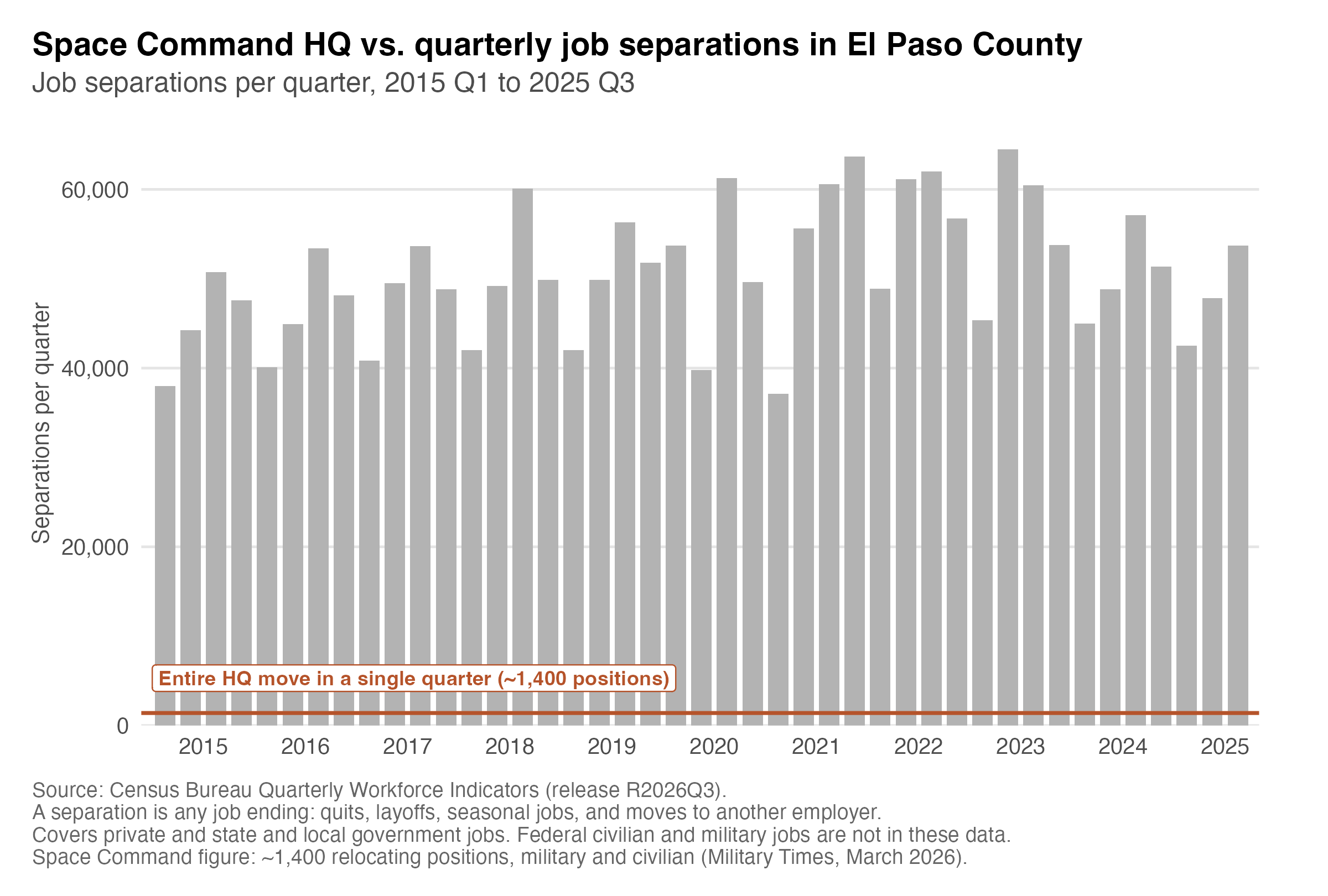
Why not? Well, let’s look at quarterly separations in El Paso County going back to 2015.
The chart below shows the number of positions to be moved from Colorado Springs to Huntsville and the number of job separations (quits, layoffs, seasonal jobs, moves to another employer) every quarter for the last decade. This data, like the payroll jobs data, does not count military personnel and is also missing federal civilian positions. But it does show that the number of positions being moved is only a small fraction of the typical number of separations in a single quarter. And I’ll emphasize again that the transition is happening over several years.
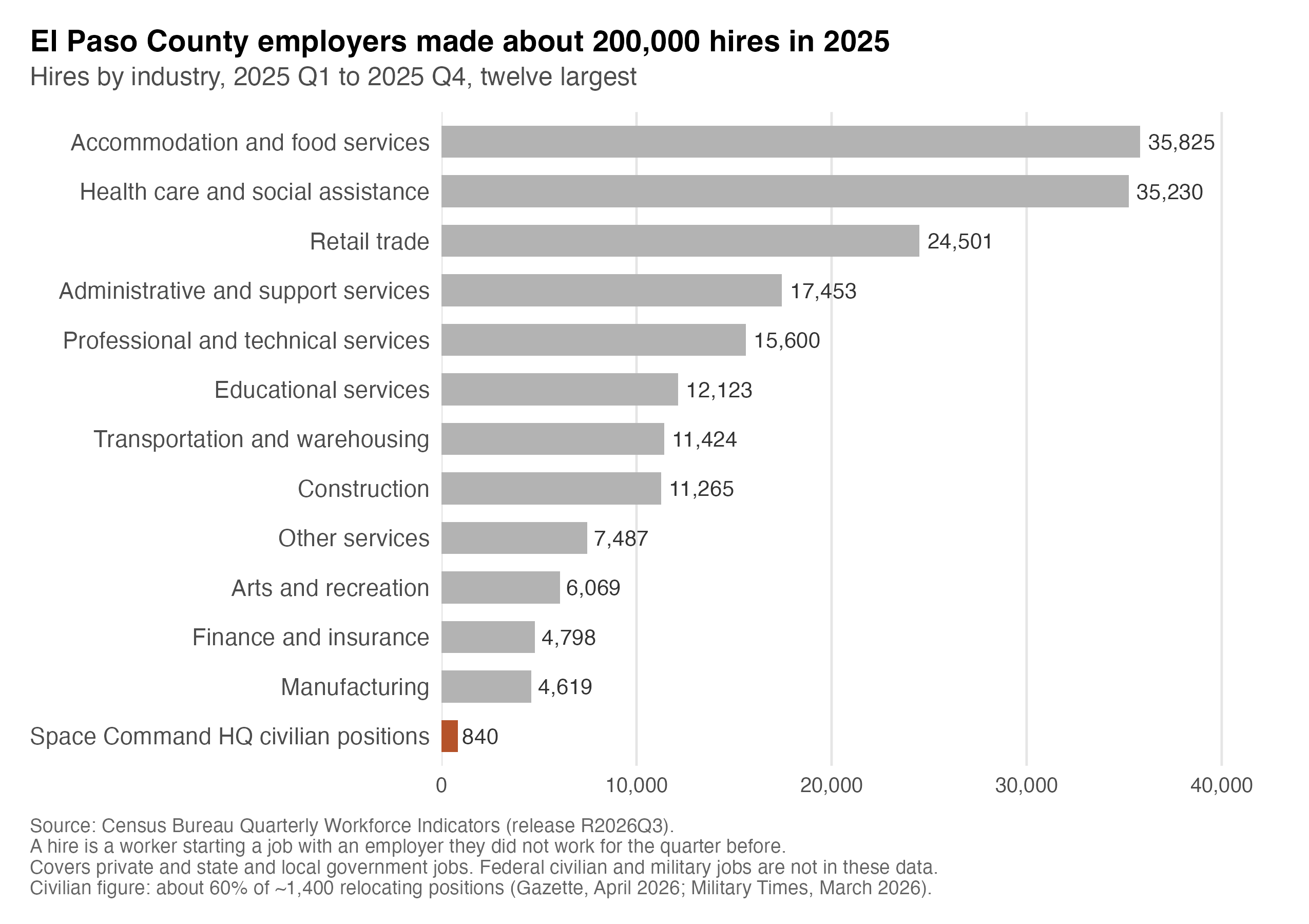
Then what about the civilians who are not ordered to move? The Gazette reporting linked above had civilian positions at 60%, which means perhaps as many as 840 people will choose to stay when their positions are relocated. The final chart shows hires by industry in 2025 in El Paso County. Here too, it seems unlikely that the county will have difficulty absorbing 840 people when their positions move. Now, it’s possible that the civilian workers from Space Command HQ held highly specialized positions and will hold out for the right job, but we can’t say much more than that without knowing more about those positions.
All this to say, if we can expect job losses to be limited to the 1,400 positions being moved and the pace goes as planned, this will be a relatively minor employment shock for El Paso County and almost certainly nothing like an economic downturn.
Conclusion
My point here is not that people are wrong to care about losing Space Command HQ. The military personnel who are having their positions relocated don’t have a choice in the matter. They may have been in the area for years and raised their kids there, and now they must uproot their families. The civilians face a difficult choice of their own. Leave the area, or stay and look for new work. These are not easy situations to be in.
But if the question is should we expect major economic pain for the local economy, it seems pretty clear to me that won’t be the case. Those who made more cautious predictions when this was discussed a couple years ago, and who have since been clear that the hit will not be massive, have had the right perspective.